
What Is Starlink? Complete 2026 Guide to Satellite Internet in Syria
A complete 2026 guide to Starlink satellite internet: how the low-earth-orbit network works, why it is different from older satellite internet, what performance to expect in Syria, and how users can get started through roaming plans.

Starlink is a satellite internet system developed by SpaceX. Instead of relying on damaged copper lines, overloaded mobile towers, or fiber infrastructure that may not reach rural areas, Starlink sends internet data between a small user terminal and thousands of satellites in low Earth orbit. In practical terms, it can deliver download speeds around 50 to 200 Mbps with latency often in the 20 to 60 ms range under good conditions.
For Syria, this matters because the satellites physically pass above the region even though the country is not yet listed as a fully supported official Starlink market. Many users therefore depend on roaming-based activation through accounts created in supported countries. The important idea is simple: the signal is available in the sky, but the account, plan, setup, and local compliance details must be handled carefully.
This guide explains what Starlink is, how it works, why it is different from traditional satellite internet, what speeds users can realistically expect in Syria, and how to think about devices, power backup, weather, and support before buying.
What Is Starlink?
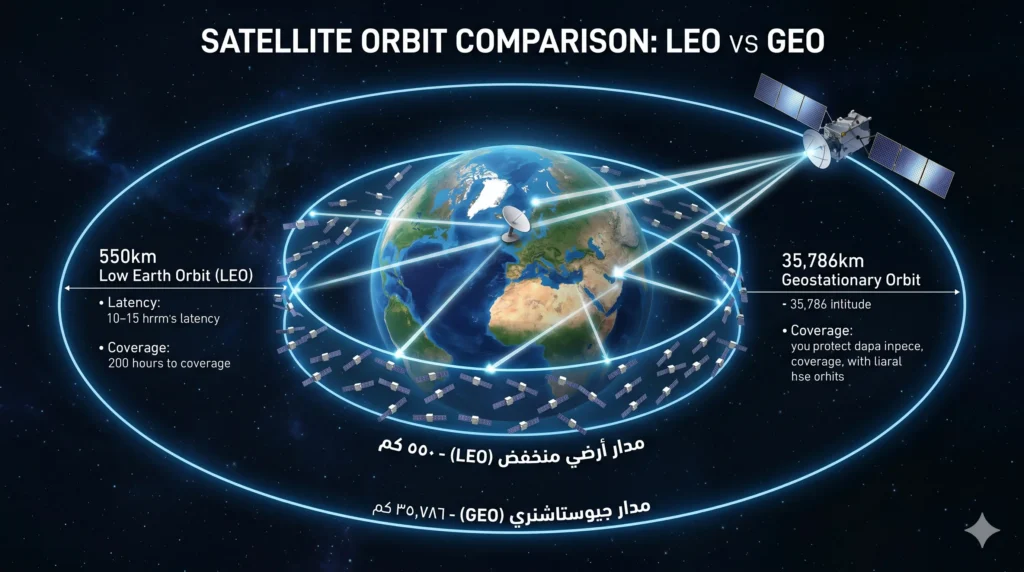
Starlink is a global satellite internet network built by SpaceX. The basic idea is different from normal land-based internet. Your Starlink dish connects to satellites moving above you, and those satellites route traffic through the wider Starlink network and ground infrastructure.
The biggest technical difference is orbit height. Older satellite internet systems usually depend on geostationary satellites about 35,786 km above Earth. Starlink satellites operate much closer, commonly hundreds of kilometers above Earth in low Earth orbit. That shorter distance is the main reason Starlink can feel much more responsive.
Low Earth Orbit vs. Traditional Satellite Internet
| Metric | Starlink LEO | Traditional GEO satellite |
|---|---|---|
| Orbit height | About 340-570 km | About 35,786 km |
| Typical latency | 20-60 ms in ideal conditions | 600+ ms |
| Typical speed | 50-200 Mbps | 15-30 Mbps |
| Video calls | Usually practical | Often difficult |
| Online gaming | Possible, depending on routing | Usually impractical |
Think of traditional satellite internet as sending every request to a faraway point in space before it returns. Starlink brings that path much closer to Earth, so pages load faster, calls feel smoother, and real-time work becomes more realistic.
The Starlink Satellite Network in 2026

By 2026, Starlink has become the largest active satellite internet constellation in the world. Public tracking and industry reports describe thousands of active satellites in low Earth orbit, with SpaceX continuing to launch additional capacity. The result is better coverage, higher network capacity, and more consistent performance across many regions.
Each satellite is not working alone. The network uses a combination of user terminals, satellites, laser links between satellites, and ground stations. When you open a website or join a video call, the path usually looks like this:
- Your phone, laptop, or router sends data to the Starlink dish.
- The dish connects to a Starlink satellite passing overhead.
- The data moves through Starlink's satellite and ground network.
- The response returns through the same network in a fraction of a second.
This architecture is why Starlink can serve places where fixed infrastructure is weak, damaged, congested, or simply unavailable.
How Does Starlink Reach Syria?
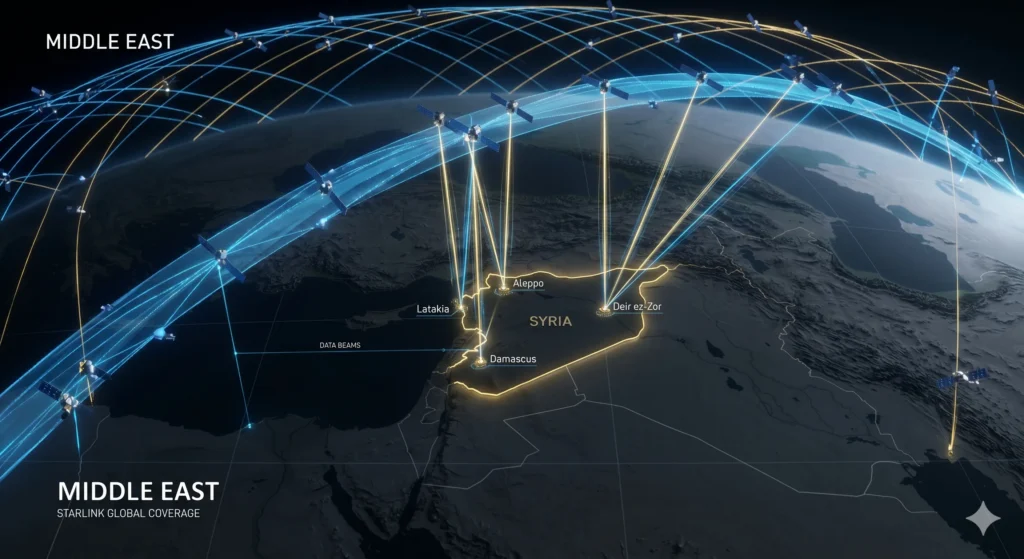
The practical question for Syrian users is not whether satellites pass above Syria. They do. The more important question is how the service is activated and used when Syria is not listed as a fully supported official market.
The technical reality: Starlink coverage exists physically across the region. However, official service availability depends on Starlink's country list, regulatory status, and supported plans.
The common practical route: many users rely on a Starlink account created in a supported country and use a suitable roaming plan. This usually involves buying the device, creating or transferring the account correctly, activating the plan, and then installing the dish in Syria with clear sky visibility.
That is where guidance matters. A wrong account region, unsuitable plan, blocked payment method, or poor installation location can turn a powerful system into a frustrating experience. At Starlink Syria, the goal is to help users understand these steps before they spend money.
Realistic Speeds in Syria
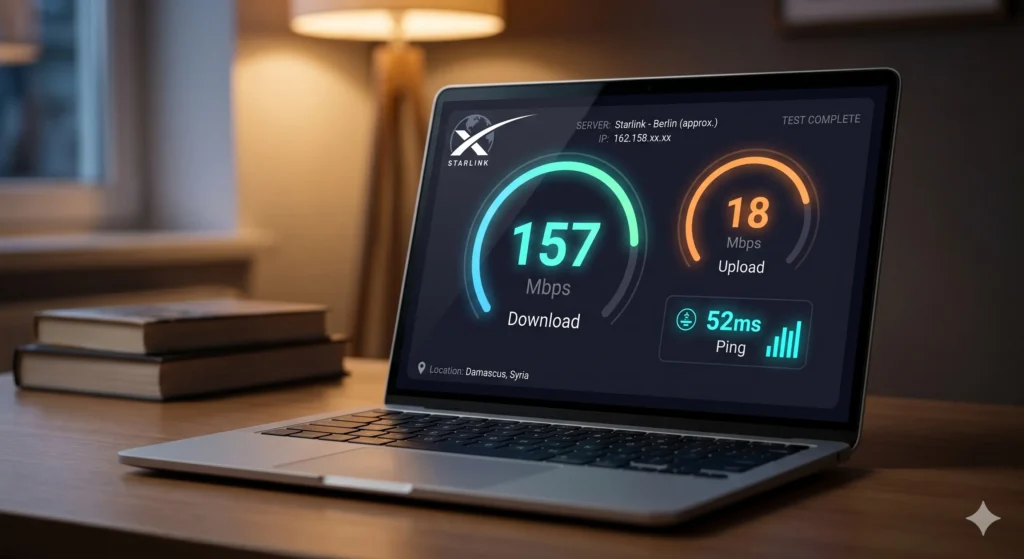
Performance changes by location, sky visibility, network load, plan type, router placement, weather, and the server you are connecting to. Still, users in the region commonly expect performance far beyond traditional local fixed-line internet.
| Metric | Practical range | Notes |
|---|---|---|
| Download speed | 50-200 Mbps | Varies by time, location, and congestion |
| Upload speed | 10-20 Mbps | Useful for calls, cloud work, and uploads |
| Latency | 40-80 ms in many regional tests | Often measured to European servers |
| Stability | Strong with clear sky visibility | Heavy rain or bad placement can reduce quality |
Compared with slow ADSL lines or overloaded mobile networks, Starlink can be a major upgrade. A one-hour Zoom meeting, a cloud backup, a remote-work session, or a large software download becomes much more practical when the connection is stable.
Starlink for Rural Syria
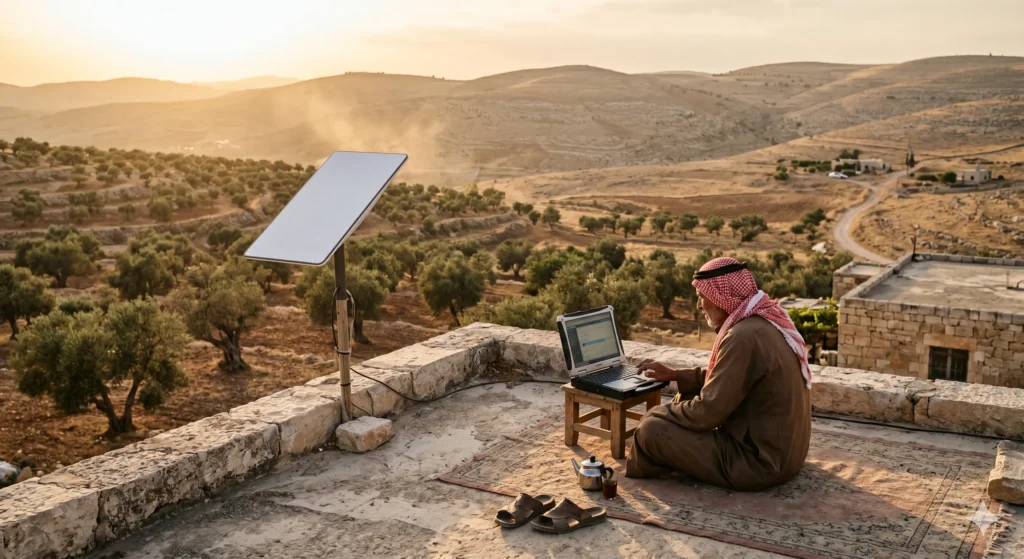
In many rural areas, the question is not whether Starlink is better than a normal connection. The question is whether any reliable connection exists at all. Some villages have no usable ADSL, weak mobile coverage, and no realistic fiber plan in the near future.
For these users, satellite internet can unlock work, education, communication, and business tools that were previously out of reach. Teachers, freelancers, students, small workshops, medical offices, and remote teams all benefit from a connection that does not depend on a nearby street cabinet or cell tower.
Weather, Heat, Dust, and Power
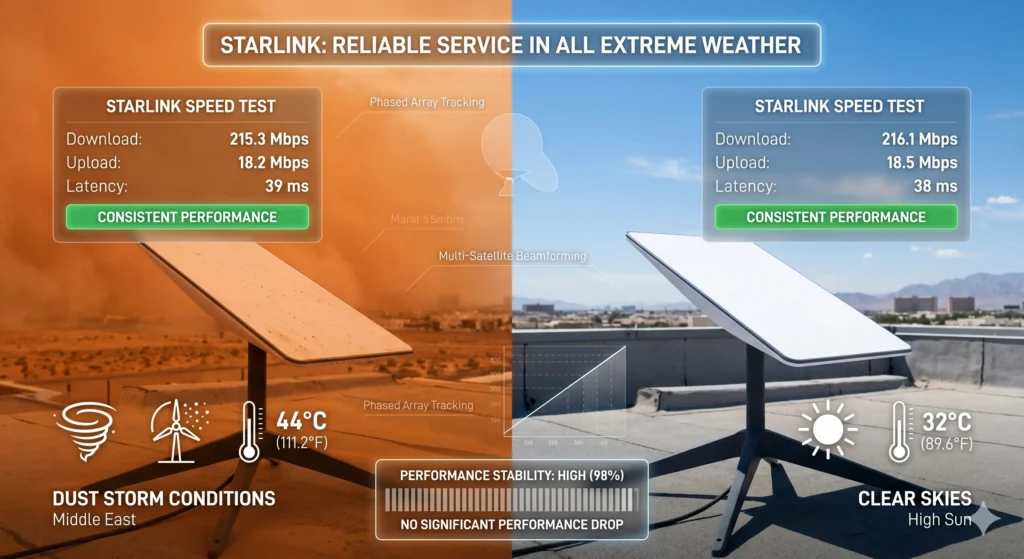
Heat: Starlink hardware is designed for outdoor use and can tolerate hot conditions, but installation still matters. Good airflow, a safe mounting position, and avoiding unnecessary heat exposure help preserve performance.
Rain: heavy rain can temporarily weaken satellite signals. In most normal rain conditions the connection should continue, but severe storms can reduce speed or cause short interruptions.
Dust: dust and sand are usually less harmful to the radio signal than people expect, but the dish should still be installed securely and cleaned carefully when needed.
Electricity: power is often the biggest Syrian challenge. A Starlink system needs stable electricity, so many users pair it with a UPS, battery, inverter, or solar setup. Starlink Mini is especially attractive for low-power setups because it consumes much less power than larger kits.
Which Starlink Device Should You Choose?

There is no single perfect Starlink device for every user. The right kit depends on how and where you plan to use it.
| Device | Best for | Power use |
|---|---|---|
| Standard Kit | Homes and fixed offices | Moderate |
| Starlink Mini | Mobility, rural use, solar or battery setups | Lower |
| Flat High Performance | Business, demanding conditions, vehicles, heavy use cases | Higher |
For many Syrian households and small businesses, Starlink Mini can be the most practical option because it is easier to power during outages. For heavier business use, a larger kit may still make sense.
Why Starlink Instead of Other Options?
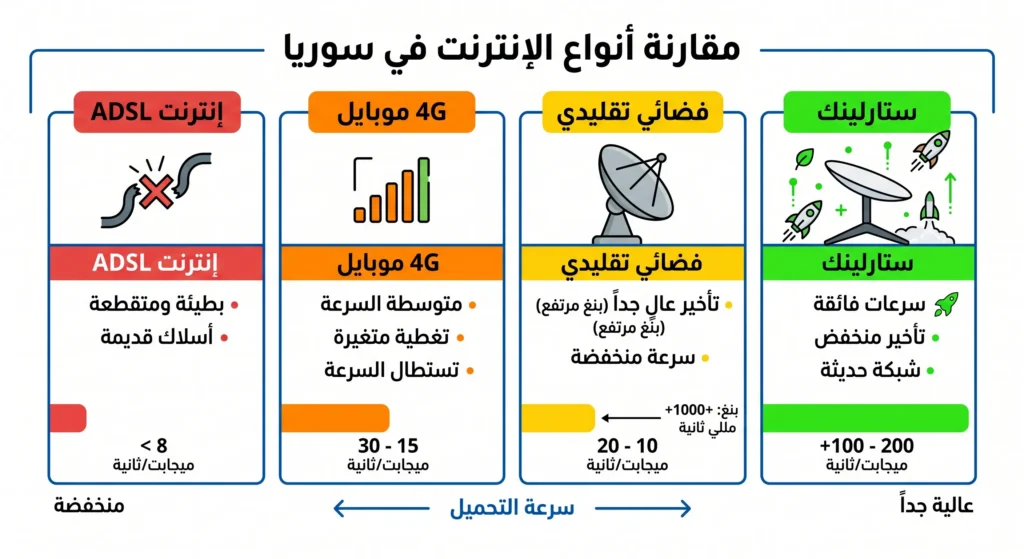
| Option | Strength | Main weakness |
|---|---|---|
| Starlink | High speed, broad coverage, low latency for satellite | Needs correct account, plan, installation, and power |
| ADSL | Cheap where available | Often slow, unstable, or unavailable |
| 4G/mobile | Easy to start | Coverage and congestion vary heavily |
| Traditional satellite | Works in remote areas | High latency and weaker real-time performance |
Starlink is not the cheapest path, but it can be the most serious path when productivity, remote work, study, or business continuity depends on a strong connection.
How Starlink Syria Helps

Starlink Syria is a guidance-focused platform for people who want to understand satellite internet before buying. We help users compare device options, understand plan requirements, prepare for power backup, and avoid common setup mistakes.
- Clear guidance for choosing the right device and plan.
- Step-by-step help with setup and activation questions.
- Practical advice for power backup, mounting, and router placement.
- Transparent information so users know the limits before they buy.
Your next step is simple: contact us, tell us your location and use case, and we will help you understand the most suitable Starlink path for your situation.

Article FAQ
Does Starlink work in Syria?
Yes, Starlink works technically in Syria — but not via a direct Syrian subscription. The proven method is registering the device in a licensed country and activating the Global Roam plan ($165/month), which enables connectivity from anywhere the satellites cover, including Syrian territory. Thousands of Syrians are doing this today. We guide you through every activation step to ensure a stable, reliable connection.
How much does Starlink cost in Syria in 2026?
The cost has two components: the hardware, which runs $800–$1,500 on the Syrian market (vs. $349–$599 globally), and the monthly Global Roam subscription at $165/month. Total first-year cost typically ranges between $2,800 and $3,500. It's a significant investment — but one that delivers 100–200 Mbps stable connectivity instead of unreliable ADSL.
Is Starlink legal in Syria?
The legal situation is nuanced — not a flat-out ban. Starlink is not yet officially licensed in Syria, but the Ministry of Communications is actively negotiating with SpaceX, with licensing announcements potentially imminent. Enforcement actions have targeted commercial smugglers, not individual users. Thousands of households and businesses are currently using it.
What Starlink hardware is available and which is right for Syria?
Three main options: Standard Kit (best for home and office use in Syria), Mini (portable, lighter, lower cost, ideal for mobility), and Business Kit (for institutions needing network priority).
What actual speeds can I expect from Starlink in Syria?
Based on real user data from across Syria: download speeds of 100–200 Mbps, upload 10–20 Mbps, and ping latency of 40–80ms — vastly outperforming Syrian ground-based internet. Rural areas often achieve better performance than major cities due to lower network cell density.
Reader Ratings
★★★★★ (1)
مقال رائع شكراً لكم.
Related Articles
Activate Starlink in Syria 2026: Coverage, Plans, Legal Guide
Practical guide to activating Starlink in Syria, choosing the right roaming plan, understanding coverage, and avoiding account or legal issues.
Read
Starlink Internet in Syria 2026: Prices, Setup, Speeds | Starlink Syria
Complete guide to Starlink internet in Syria, including device prices, monthly plans, setup steps, expected speeds, and performance tips.
Read