
Starlink Legal Status in Syria 2026: The Full Truth Nobody Tells You
Is Starlink allowed or banned in Syria? The complete answer: Starlink is not officially licensed, yet thousands use it via Global Roam. We cover the Telecom Authority's ruling, SpaceX-Ministry negotiations, and how the Caesar Act repeal reshapes everything — documented facts for 2026.
Starlink is not officially licensed in Syria as of May 2026, yet it works in practice for thousands of Syrians using the Global Roam plan. The Telecom and Post Regulatory Authority requires prior authorization for device possession, with enforcement actions focused on illegal commercial distributors. Meanwhile, the repeal of the US Caesar Act in December 2025 has opened serious doors toward imminent formal licensing.
If you're asking "Is Starlink allowed in Syria?" you're asking the right question — but the answer is far richer than what a 10-second Google search returns.
The legal status of Starlink in Syria is neither black nor white. It occupies a carefully nuanced grey zone shaped by three interlocking forces: Syrian domestic regulation, a cascading rollback of US sanctions, and behind-the-scenes diplomatic-technical negotiations. This article connects all these threads in one place, giving you the full picture you need to make a genuinely informed decision.
I — What Syrian Official Authorities Actually Say
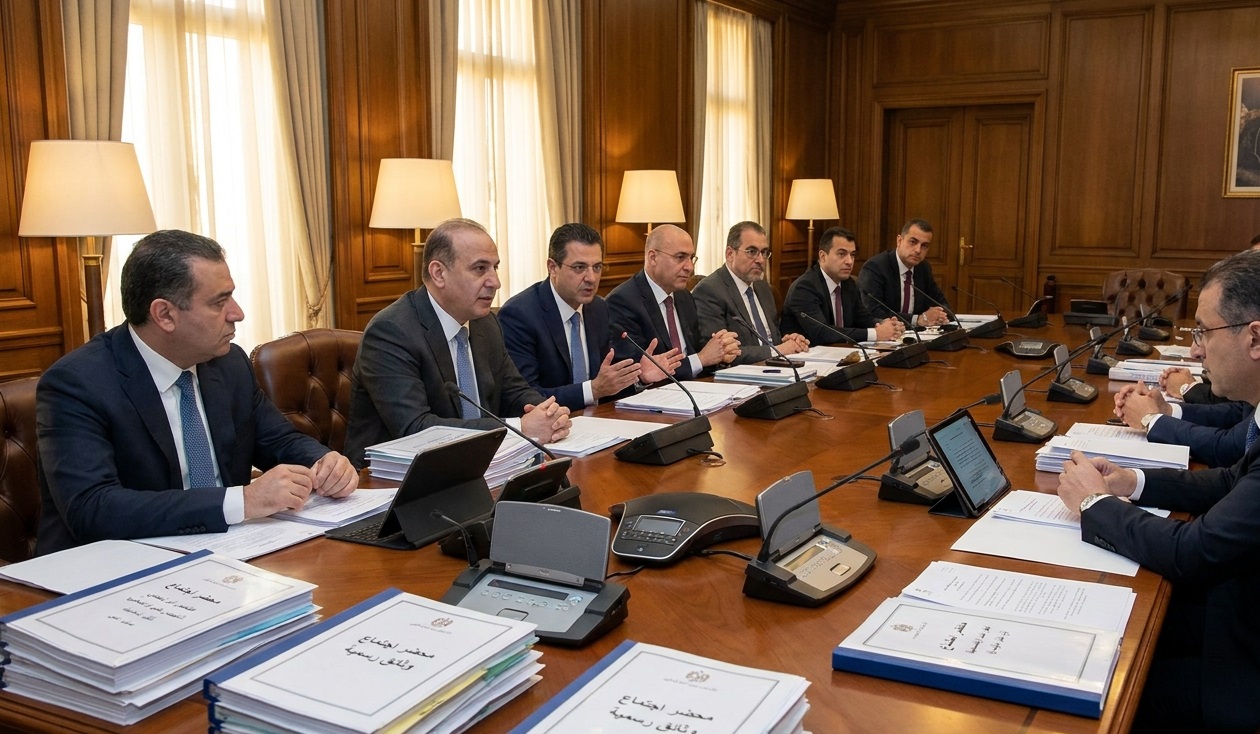
The Telecom and Post Regulatory Authority's Decision
Syria's Telecom and Post Regulatory Authority officially prohibited the possession of Starlink internet terminals and other satellite internet services without obtaining prior authorization, confirming that doing so constitutes a legal violation. SANA
This ruling requires prior authorization before possessing a device — but the ground reality is significantly more nuanced than this single statement suggests.
Who Do Enforcement Actions Actually Target?
Syria's Communications Minister Abdulsalam Haykal publicly clarified that the ministry is open to all technologies provided they operate within the framework of national laws, and that enforcement measures targeted smugglers seeking to exploit high demand rather than individual users. L24
This distinction is critical: the target is those who illegally traffic devices commercially or run unlicensed distribution networks — not residential users with a single dish.
Exceptional Cases That Qualify for Licensing
The Telecom and Post Regulatory Authority stated it considers licensing requests from governmental entities, embassies, and international organizations only, and in emergency cases where local ISPs cannot provide service. SANA
This means humanitarian organizations and official entities have a clear licensing pathway — while the individual user's case remains legally ambiguous.
II — The Critical Distinction: "Unlicensed" ≠ "Criminally Banned"
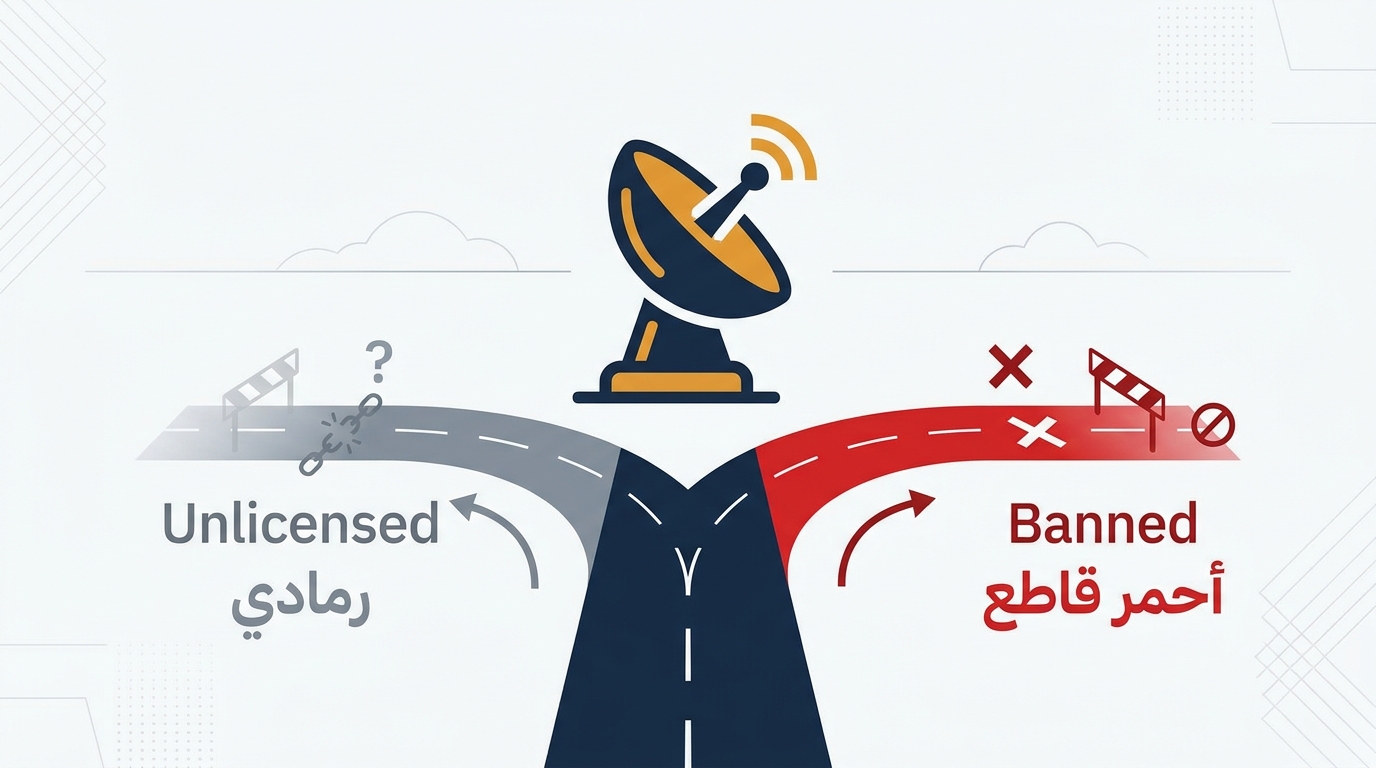
This is the single most important concept in this article, and the one most absent from news coverage.
| Criterion | Unlicensed | Criminally Banned |
|---|---|---|
| Formal operating agreement with Syria | ❌ No | ❌ No |
| Explicit criminal penalty for individual use | ⚠️ Partial | ✅ Full |
| Device confiscation risk | ⚠️ Possible | ✅ Systematic |
| Primary target of enforcement | ❌ (Distributors) | ✅ Everyone |
| Future licensing possibility | ✅ Negotiations active | ❌ |
Starlink in Syria currently falls in the "unlicensed" category — SpaceX has not signed a government operating agreement, not that there's an explicit criminal statute that punishes personal residential use.
III — The Historical Arc: How Did We Get Here?
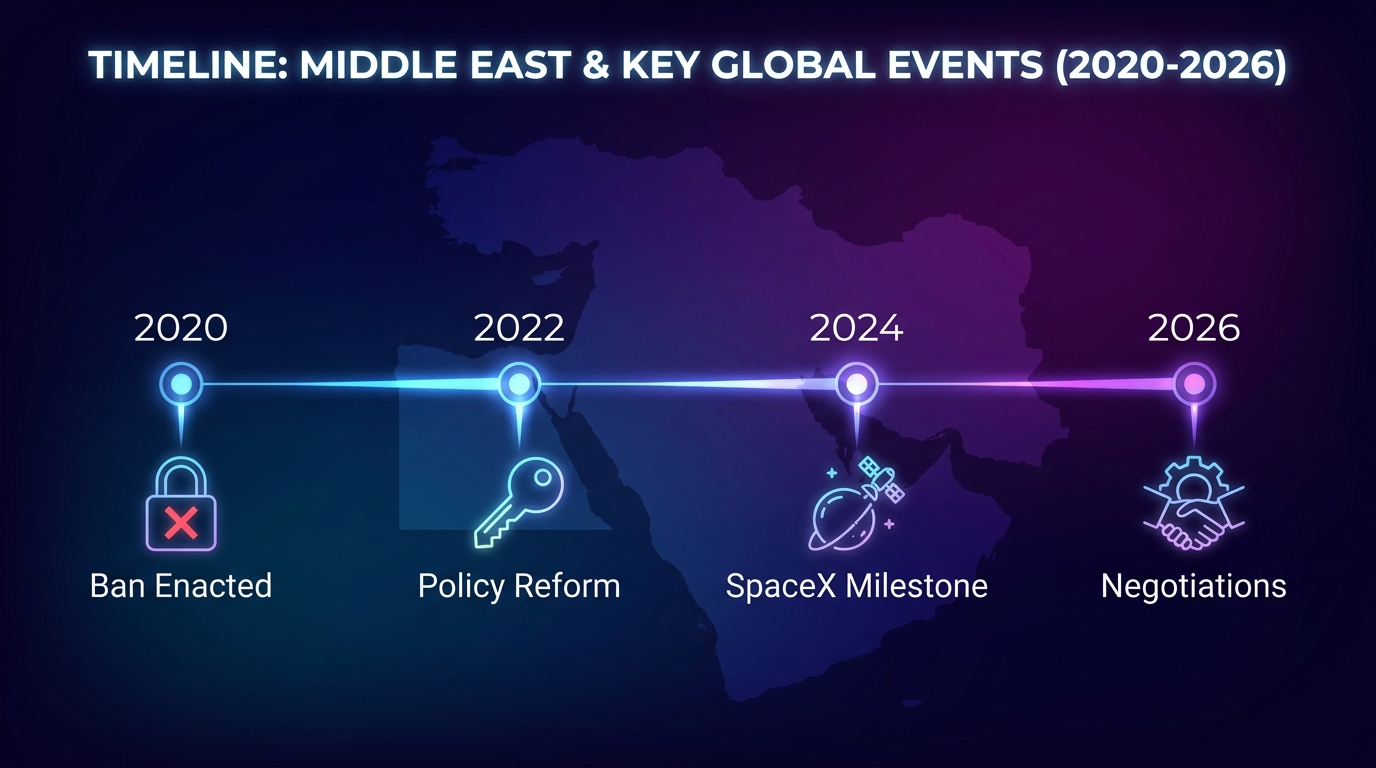
The Pre-December 2024 Era
Under the former regime, any satellite communication outside state-controlled infrastructure was treated as a security threat. Starlink wasn't merely "unlicensed" — it was effectively unthinkable to discuss publicly.
After December 2024 — A Landscape Transformed
The fall of the regime and formation of the transitional government under Ahmed al-Sharaa fundamentally changed the equation. The transitional government adopted an openly pro-investment, pro-technology posture, and the Regulatory Authority began acknowledging that the situation required structured resolution rather than confrontation.
The Rapid Escalation of 2025–2026
- January 2025: Regulatory Authority grants a grace period for status normalization and announces it is studying exceptional licensing cases.
- March 2025: Syria's Ministry of Communications confiscated 55 Wi-Fi broadcasters and Starlink satellite internet devices, claiming they threatened the "national revenue" of the ministry and caused "damage to the frequency spectrum." IFEX
- May–November 2025: The United States suspended imposition of Caesar Act sanctions on Syria for 180 days, halting sanctions on most commercial transactions with the Syrian side. globalsecurity
- December 2025: The US Congress fully repealed the Caesar Act within the FY2026 National Defense Authorization Act, ending the broad secondary sanctions authorities that had discouraged American companies — including SpaceX — from formally entering the Syrian market. Curtis
- February 2026: Reports indicated significant progress in negotiations between Syria's Ministry of Communications and SpaceX, with indications that Starlink may agree to licensing fees enabling its formal operation in the country. L24
IV — The Barriers That Blocked Licensing (And What's Changed)
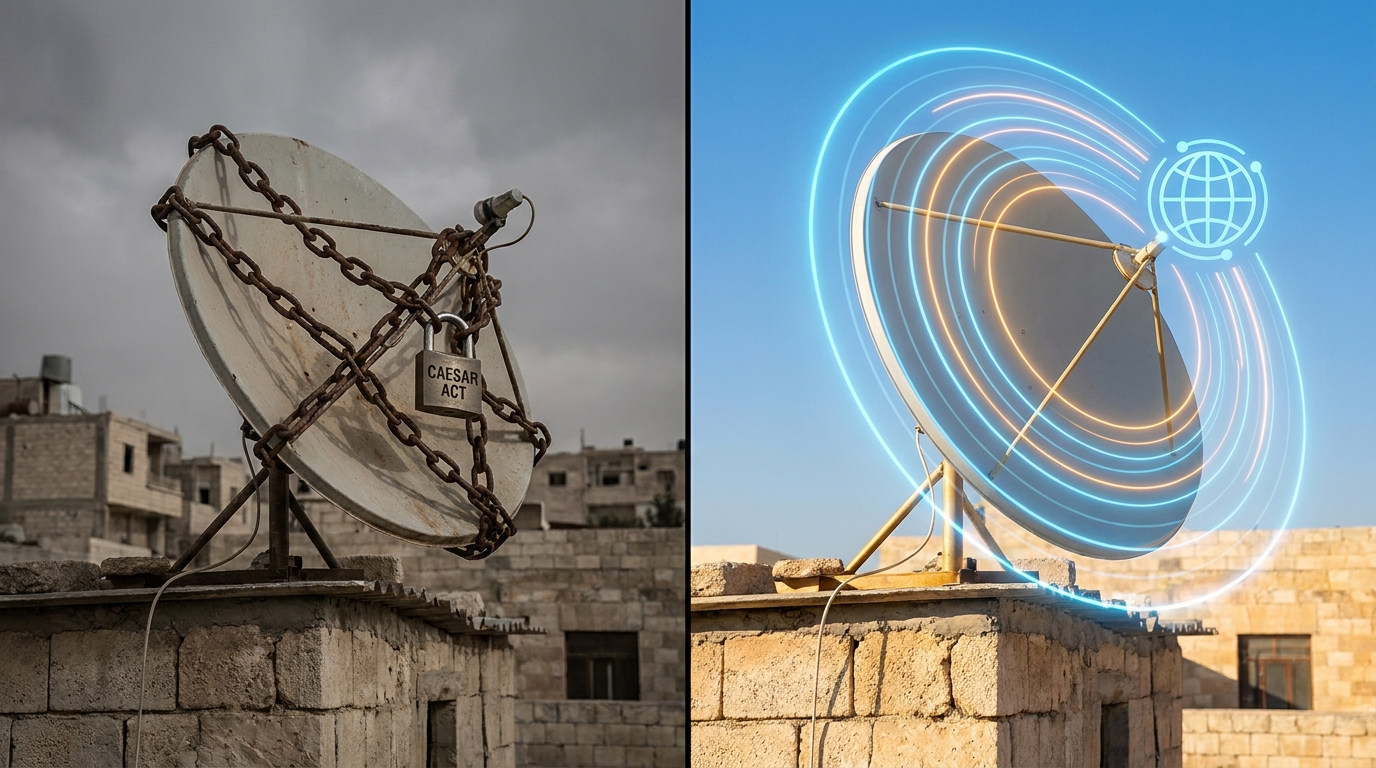
Barrier One — US Sanctions (Substantially Removed)
American satellite companies must comply with US government export laws that restrict provision of certain technologies to sanctioned nations. Syria was subject to various US trade and technology restrictions for years, complicating formal service agreements. The Viral News
The Caesar Act repeal in December 2025 removed the largest legal barrier. What remains is the local regulatory barrier — solvable through ongoing negotiations.
Barrier Two — No Local Operating Agreement
Syria is "hard-blacklisted" in Starlink's own data, alongside Afghanistan, Belarus, China, North Korea, and Russia. Mappr
But this classification reflects the absence of formal licensing — not technical impossibility or a permanent final refusal. Starlink's satellites already cover Syria. The signal is there. What's missing is a signed agreement.
Barrier Three — The Competitive Infrastructure Narrative
Large-scale infrastructure projects backed by the Syrian government, including the SilkLink agreement with Saudi Telecom Company to deploy thousands of kilometers of fiber-optic infrastructure, and the BarqNet project targeting 1Gbps speeds, shape a negotiating context where officials want to frame Starlink as a complement to national networks, not a replacement. L24
V — How Thousands of Syrians Use Starlink Right Now
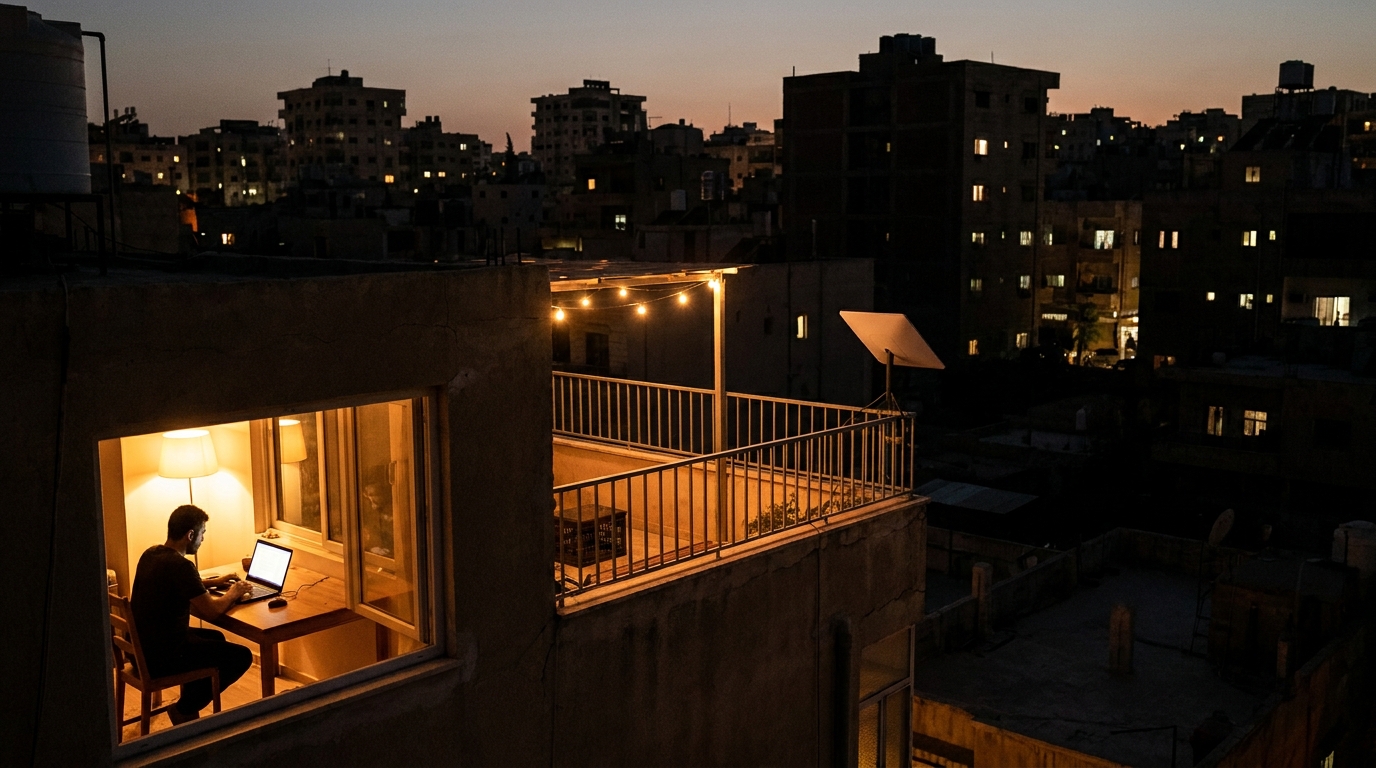
The reality is that many aren't waiting for formal licensing — they have genuine, pressing needs that won't wait.
The most widespread approach involves three steps:
- Acquire a Starlink device — from the Syrian market or via intermediaries outside Syria.
- Register in a licensed country — Jordan, Turkey, Cyprus, or various European and African countries.
- Subscribe to the Global Roam plan — which technically allows device usage from anywhere the satellites cover, irrespective of local regulatory status.
This path doesn't represent a "legal loophole" in the strict sense — it places licensing responsibility on the state, not the individual user. But it doesn't constitute "official permission" either.
A note from our field experience: The most common and costly mistake users make is subscribing to the cheaper Regional Roam plan instead of Global Roam. This exposes them to service suspension from SpaceX itself — a risk entirely separate from Syrian legal status. Don't let budget constraints cost you more in the long run.
VI — Real Risks of Current Usage: What You Must Know
We won't overstate the risks, nor minimize them. Here's an honest breakdown:
✅ Lower Risk:
- Quiet personal use at home or office.
- Usage in remote areas lacking local internet infrastructure.
⚠️ Moderate Risk:
- Distributing internet from a Starlink subscription to paying customers, which Syria's Ministry of Communications explicitly considers a regulatory violation. Enab Baladi
- Publicly displaying the device in areas with heightened security monitoring.
🔴 Higher Risk:
- Importing devices in commercial quantities for resale without licensing — this is what field enforcement actually targets.
- Operating a large-scale commercial network using Starlink as primary provider without authorization.
VII — What Changes in 2026? A Historic Window of Opportunity
2026 carries variables that are reshaping the entire landscape:
1. Caesar Act Repeal — The Biggest Shift: The repeal of the Caesar Syria Civilian Protection Act removes one of the most restrictive and uncertainty-producing elements of the US sanctions framework on Syria. Legally, it ends the authorities that allowed for broad secondary sanctions. Politically, it signals a recalibration in US policy toward engagement and economic stabilization rather than prolonged isolation. Belfer Center for Science and International Affairs
2. Advanced Starlink Negotiations: Officials have framed Starlink's potential entry as a complementary service rather than a substitute for national networks, placing the government in a comfortable position to accept licensing without appearing to concede sovereignty over infrastructure. L24
3. Syria's Removal from the State Sponsors of Terrorism List: This diplomatic shift opens the door for American telecom companies to engage formally with the Syrian market without fear of legal repercussions in their home jurisdictions.
VIII — Practical Guidance: How to Navigate the Current Reality Intelligently
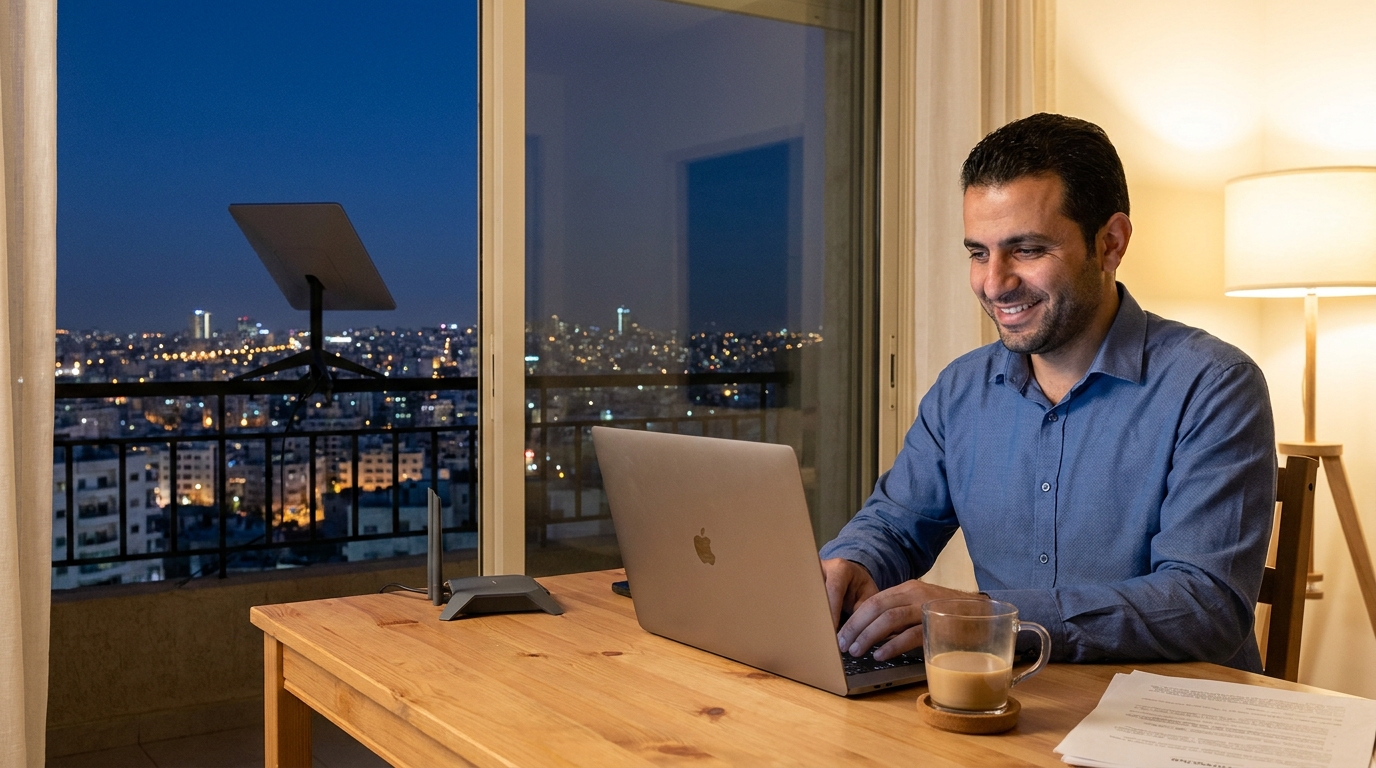
Based on our close tracking of this issue and deep field experience in the Syrian market:
- Don't ignore the legal landscape — and don't catastrophize it either. Both extremes are costly.
- Choose Global Roam if you proceed — it's the technical guarantee from SpaceX that your service continues regardless of your geographic location.
- Exercise judgment on commercial use until the licensing picture clarifies.
- Follow developments actively — major shifts are happening fast in 2026.
If you need Starlink for work, study, or staying connected to the world, and don't want to navigate the maze of technical details alone, our team is ready to accompany you step by step until your first successful connection — from initial assessment, through device and plan selection, to complete setup and activation.
Internal Links (Reference Section)
🔗 Related articles on our site for internal linking:
- [Internal Link ← Article #7] "Is Starlink Allowed in Syria? A Definitive, Detailed Answer for 2026" — deeper dive into personal legal implications.
- [Internal Link ← Article #2] "Starlink in Syria 2026: The Complete Guide" — for readers who want to start from scratch.
- [Internal Link ← Article #10] "How to Activate Starlink in Syria Step by Step" — for those ready to move from knowledge to action.
- [Internal Link ← Article #12] "Global Roam Plan: The Only Safe Option for Syria" — to understand the right plan within the legal context.
- [External Link ← levant24.com] "Starlink in Syria: From the Gray Market to Formal Regulation" — credible external source supporting the article's claims.
Strong Conclusion
The bottom line you take away from this article: Starlink in Syria is neither banned in absolute terms nor licensed in the official sense — it occupies a narrowing grey zone that shifts with every political and diplomatic development. That grey zone, with all its ambiguity, is the reality you must engage with intelligently — neither recklessly nor paralyzed by overblown fear.
The Caesar Act repeal, SpaceX's advanced negotiations with the Ministry of Communications, and the transitional government's openness to modern telecom technology — all of these signals point toward a resolution in favor of formal licensing. Until that moment arrives, thousands of Syrians are achieving their productivity and daily connectivity through Starlink.
Are you ready to be one of them — thoughtfully and safely?
[Contact us now via WhatsApp] — our team is with you from the very first moment until your screen lights up with real, reliable satellite internet.

Article FAQ
Is Starlink allowed in Syria?
Starlink is not officially licensed in Syria as of early 2026, but it is not criminally banned for individual users in the strictest sense. The Telecom and Post Regulatory Authority requires prior authorization to possess and use the device, and enforcement actions have primarily targeted illegal commercial distributors rather than individual residential users. If you need reliable satellite internet for work or communication, [contact us on WhatsApp] to understand the safest path for your specific situation.
What is the difference between "unlicensed" and "fully banned" in Starlink's case in Syria?
"Unlicensed" means Starlink has not yet received formal approval from Syria's Telecom Regulatory Authority to operate commercially in the country — i.e., SpaceX has not signed an operating agreement with the Syrian government. "Fully banned" would mean the law explicitly criminalizes individual use with a clear penalty. Based on official statements, Syria is in the "unlicensed" category, not a total criminal ban for personal users.
Does the repeal of the US Caesar Act affect Starlink's future in Syria?
Yes, significantly. In December 2025, the US Congress fully repealed the Caesar Act within the FY2026 NDAA, removing a major legal barrier that had prevented American tech companies — including SpaceX — from formally entering the Syrian market. This development makes the ongoing Ministry of Communications-SpaceX negotiations substantially more likely to produce a formal licensing agreement.
Can I use Starlink in Syria via Global Roam without risk of device confiscation?
Thousands of users in Syria currently access Starlink via Global Roam after registering their device in a licensed country. Syria's Communications Minister publicly stated that enforcement targets smugglers and illegal commercial operators. However, the legal situation remains grey and carries risk. For an accurate assessment of your specific case, [contact us on WhatsApp] before making any decisions.
When will Starlink get official licensing in Syria?
No confirmed date exists, but several indicators point toward resolution: confirmed SpaceX-Ministry negotiations, the Caesar Act repeal, and the transitional government's openness to modern telecom technology within the SilkLink framework. Expert projections suggest 2026–2027 could be the window for a formal announcement.
Reader Ratings
★★★★★ (1)
اشتريت من عندكم وركبته والانترنت رااائع
Related Articles
No related articles yet.